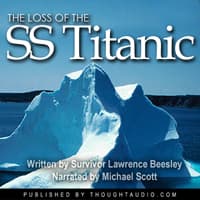

Look, I picked this one up on a whim during a short drive to meet a client in San Antonio. An hour and fifteen minutes - perfect for the round trip, right? And honestly, I've always had a weird fascination with the Titanic. Not the movie (Linda's made me watch that enough times), but the actual disaster. The logistics of it. The failures. The human element when everything goes sideways.
So here's a firsthand account from a guy who was actually there. Lawrence Beesley. Science teacher. Survivor. Wrote this thing in 1912, basically while the bodies were still being recovered. That's... something.
The Real Deal
Let me cut to the chase - this isn't your typical Titanic drama. No romance subplot, no "I'm the king of the world" moments. Beesley was a methodical guy, and it shows. He's documenting what he saw, what he heard, what he pieced together from other survivors. It's clinical in places, almost like an after-action report. And honestly? That's what makes it valuable.
I've read plenty of accounts written decades after events by people who weren't there. They're polished, dramatic, and usually full of details that sound great but smell like fiction. Beesley's account is the opposite. He admits when he doesn't know something. He's careful about what he claims versus what he observed. The author clearly did their homework - because he literally lived it.
There's this moment where he describes the ship's band playing as people loaded into lifeboats. No dramatic buildup. Just... matter of fact. "They played." That hit different than any Hollywood version ever could. Sometimes the most powerful thing you can do is just state what happened.
Michael Scott Behind the Mic
Okay, so the narrator. Not that Michael Scott. (I checked. Different guy.) His delivery is straightforward, almost documentary-style. Clean. Professional. No dramatic pauses or theatrical voice changes.
Is that a problem? Depends what you're looking for.
For this particular book, I think it works. Beesley wasn't writing drama - he was writing testimony. Scott's steady, no-frills approach matches the source material. You're not getting swept up in emotion; you're getting information delivered clearly. Some folks will find it monotone. I get that. But I've sat through enough briefings delivered by guys who thought they were auditioning for Shakespeare. Sometimes you just want the facts delivered straight.
That said - and I'll be honest here - I couldn't find much about Michael Scott's other work online. Based purely on this performance, he's competent. Professional. Not memorable, but not distracting either. For a 75-minute historical account, that's fine by me.
What Might Bug You
Here's the thing. If you're expecting a page-turner with tension building to some climax... this isn't it. Beesley wasn't writing a thriller. He was a science teacher documenting a disaster. The pacing is methodical. He spends time on details that might seem tangential - the ship's construction, the weather conditions, the procedures (or lack thereof) for loading lifeboats.
For history buffs and disaster analysis nerds like me? Gold. For someone wanting an emotional gut-punch? You might zone out.
Also - and this is minor - the narration doesn't differentiate when Beesley quotes other people. It's all delivered in the same measured tone. Not a dealbreaker, but worth noting if you're used to narrators doing distinct voices for quoted material.
Worth Your Time? Here's the Debrief
At just over an hour, this is basically a long podcast episode. Perfect for a single commute or a focused listening session. I knocked it out before I even hit the San Antonio city limits.
What you're getting is primary source material. A guy who was there, writing while the memories were fresh, trying to make sense of what happened. Beesley makes some interesting points about hindsight bias - how easy it is to judge decisions made in chaos when you're sitting comfortably knowing how it all ends. (I've seen this scenario play out in real life. Armchair generals are everywhere.)
The audio production is clean. No weird background noise, no volume issues. Just a straightforward presentation of a straightforward account.
Is it going to change your life? No. But if you're interested in the Titanic beyond the James Cameron version, if you want to hear from someone who actually climbed into a lifeboat and watched that ship go down - this is the real thing. Unembellished. Honest. A little dry in places, sure. But authentic.
Ranger slept through most of it, which tells you something about the excitement level. But he perked up when I pulled into the parking lot, so maybe he was just saving his energy.
Mission accomplished. Short, informative, worth the listen if you're into this stuff.