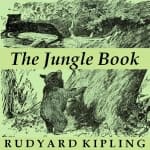
Look, I'll admit it - I came to this one with baggage. Twenty years of teaching means I've watched Disney's Jungle Book approximately 847 times during end-of-semester movie days. (Don't judge. We've all been there.) So when I queued up Kipling's original for my lakefront walks, I had to actively forget the singing bear and remember that this is actually... literature.
And it is. It really is. My students would roll their eyes at that, but here we are.
What Kipling Actually Wrote (Spoiler: Not a Musical)
Here's the thing about The Jungle Book that the adaptations gloss over - it's not just Mowgli's story. The collection includes these gorgeous standalone tales that hit completely different. Rikki-Tikki-Tavi, the mongoose story? That's a masterclass in tension. Kipling understood pacing before pacing was a buzzword. The white seal Kotick's journey is basically an environmental parable written in 1894. The man was ahead of his time.
But let's talk about what Kipling is really saying with the Mowgli stories. The Jungle Law isn't just cute animal rules - it's a meditation on belonging, on what it means to exist between two worlds and fully fit into neither. Mowgli's struggle to find his place among wolves, then humans, then back again... I mean, honestly, half my students are living that same identity crisis. Different jungle, same questions.
The prose deserves to be savored. Kipling's rhythm is almost hypnotic - these long, rolling sentences that build and build, punctuated by sharp declarations of Law. "We be of one blood, ye and I." That line still gives me chills. This is why we still read the classics. Not because some curriculum committee said so, but because the language itself does something to you.
Meredith Hughes Behind the Microphone
I couldn't find a ton about Meredith Hughes online, but based on this performance - she gets it. Her British accent feels right for Kipling without tipping into stuffy colonial territory. The pacing is measured, deliberate. She understands that pause is punctuation.
What really works is her character differentiation. Baloo's warmth comes through as this gentle, rumbling presence. Bagheera has this sleek authority. And Shere Khan - the lame tiger gets exactly the kind of smooth menace he deserves. Not over-the-top villainy, just... cold. Calculating. The kind of threat that makes you understand why the jungle fears him.
That said, some reviewers have noted the narration runs a bit quick in places. I can see that, actually. There were moments during the Monkey-People sequence where I wished she'd let the chaos breathe a little more. But honestly? At five hours, the pacing keeps things moving without dragging. I finished it over maybe four walks along the lake, and the time flew.
Who This Is Actually For
Okay, so it's marketed as kids' adventure fiction. And sure, you could listen to this with your children. But - and this is the English teacher in me talking - I'd argue adults get more out of it. The layers are there if you're looking. The colonial context is there if you want to wrestle with it. (And we probably should. Kipling is complicated. That's worth acknowledging.)
If you loved The Wind in the Willows or The Secret Garden in audio form, this is their spiritual successor. Same era, same attention to natural world detail, same undercurrent of something deeper beneath the adventure.
My students would hate this. The language is dense, the pacing patient, and nobody's scrolling through anything. I love it. Worth pausing the faculty meeting for. (Sorry, Principal Martinez.)
Fair Warning
A few things to know going in. First, this is unabridged Kipling, which means you get everything - including some dated attitudes and language that reflect 1890s British India. It's not overwhelming, but it's there. Second, if you're expecting the Disney version, you'll be surprised. Mowgli's story is darker, more ambiguous. The ending isn't wrapped up with a bow.
And third - the standalone stories after Mowgli might feel disconnected if you're not expecting them. But honestly, Rikki-Tikki-Tavi alone is worth the price of admission. That mongoose is fierce.
The Verdict
This reminds me of what Hemingway said about prose being architecture. Kipling built something here that's lasted 130 years, and Hughes' narration serves as a solid foundation for experiencing it. Not flashy, not gimmicky - just clean, expressive reading that lets the text do its work.
At 1.0x speed (because the author chose those words), this is a lovely companion for walks, commutes, or those late nights grading papers when you need something to remind you why you fell in love with stories in the first place.
My mom will probably fall asleep during this review too. But I stand by it.