
The Women's War We Never Learned About
I finished this one on a Saturday morning walk along the lakefront with Denise, and I had to stop twice because I couldn't see the path through the tears. She thought something was wrong. Something was wrong - I'd just listened to a young woman watch her father die in a Nazi prison camp. Denise handed me a tissue and said, "Is this another one of your sad history books?" Yes. Yes it was.
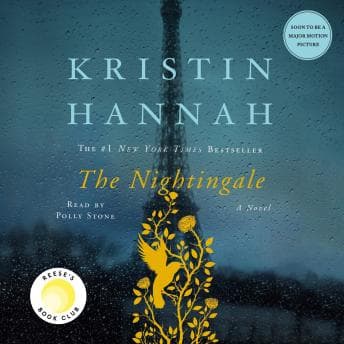
Look, I teach high school English, which means I've read approximately ten thousand WWII novels. We've all read the Holocaust narratives, the soldier stories, the resistance tales. But Kristin Hannah does something different here - she zooms in on the women who stayed behind in occupied France. The mothers trying to feed their children on rations that wouldn't sustain a cat. The wives watching their husbands march off and wondering if they'd ever come back. The sisters - and this is really what the book is about - the sisters who chose completely different paths toward survival and ended up heroes in ways neither expected.
Vianne is the older sister, the rule-follower, the one who just wants to keep her daughter safe and wait out the war. Isabelle is the younger one, the wild child, the one who can't sit still while her country burns. If you've ever taught teenagers, you know both these types. Vianne is the kid who does every assignment perfectly and never makes waves. Isabelle is the one who argues with you about Hemingway's masculinity complex and then skips class to protest something. (I've had both. I secretly love the Isabelles, even when they drive me crazy.)
Polly Stone Gets It
Here's the thing about narrating a book with two very different sisters - you have to make the listener feel the contrast without overdoing it. Polly Stone nails this. Vianne sounds tired, careful, measured. Every word she speaks carries the weight of a woman who's learned to make herself small to survive. Isabelle sounds like she's barely containing herself, like every sentence is a fuse waiting to be lit.
The French accents are... fine. Honestly, I've heard better, and some listeners might find them a little inconsistent. But Stone understands something more important than accent work - she understands that pause is punctuation. When Isabelle makes a decision that could get her killed, Stone lets the silence sit there. When Vianne discovers something horrific, the narrator doesn't rush past it. She lets you feel it.
This is why I listen at 1.0x, by the way. My students think I'm ancient for refusing to speed up audiobooks. But Hannah chose those words, chose those rhythms, and Stone interprets them with intention. Speeding through this would be like fast-forwarding through a funeral. You'd miss the point entirely.
Where It Drags (And Why That's Okay)
I'll be honest - there are stretches in the middle where the day-to-day survival stuff feels repetitive. Another ration line. Another close call with a German officer. Another night of hunger and fear. Around hour ten, I was grading papers at 11 PM and found my attention wandering toward my students' creative interpretations of The Great Gatsby. (One kid wrote that Gatsby was "basically a simp." He's not wrong.)
But here's the thing - that repetition is the point. This is what Hemingway said about war: the boredom punctuated by terror. Hannah is showing you what occupation actually felt like. Not constant drama, but grinding, endless, soul-crushing monotony interrupted by moments of absolute horror. The pacing is a choice, and it's the right one, even when it tests your patience.
The last three hours, though? I couldn't stop. I listened through a faculty meeting - sorry, Principal Martinez, I definitely wasn't paying attention to the budget presentation, I was listening to Isabelle lead downed Allied pilots over the Pyrenees - and then kept going in the parking lot because I couldn't bring myself to pause it.
What Hannah Is Really Saying
This reminds me of what I always tell my students about historical fiction: the best of it isn't really about the past. It's about the questions the past forces us to ask ourselves. What would you do? Would you hide the Jewish children in your cellar, knowing your own daughter could be killed for it? Would you walk through the mountains in winter, knowing one wrong step means death? Would you choose safety or resistance?
Hannah doesn't let you off the hook with easy answers. Both sisters make choices that are brave and choices that are cowardly. Both survive things that should have broken them. And the framing device - which I won't spoil - recontextualizes everything you thought you understood about who the "hero" of this story really is.
My students would probably hate this book. Too long, too sad, too much French. But this is why we still read the classics, why we still tell these stories. Because every generation needs to hear them again.
The Verdict
If you loved All the Light We Cannot See or The Alice Network, this is their spiritual successor. It's not a light listen - don't put this on during a workout unless you want to ugly-cry on the treadmill. But it's exactly the kind of historical fiction that reminds you why the genre matters.
Polly Stone's narration elevates already strong material. The prose deserves to be savored. And at seventeen-plus hours, you're getting a full, immersive experience that earns every minute of its runtime.
Worth pausing the faculty meeting for. Worth the tears on the lakefront. Worth your time.