
The Weight of Raskolnikov's Mind
I was grading sophomore essays on The Great Gatsby - the same five thesis statements about the green light I've read for two decades - when Expatriate started reading Raskolnikov's justifications for murder. And I just... stopped grading. Set my red pen down. Because here's the thing about Dostoyevsky: he makes you complicit. You're not just listening to a story about a man who kills a pawnbroker. You're inside his head, following his logic, and somewhere around hour three you catch yourself thinking "well, he has a point about—" and then you have to pause and take a walk around the block.
This is why we still read the classics. This is why I've been teaching for twenty years and Dostoyevsky still makes me feel like a first-year grad student who doesn't know anything.
Expatriate's Quiet Interpretation
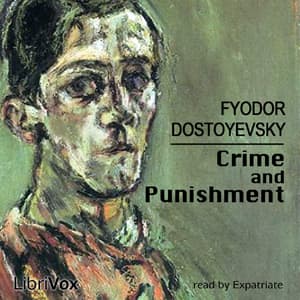
Look, I need to be honest about something: this is a LibriVox recording, which means it's volunteer-narrated and free. And Expatriate - that's the narrator's handle, I couldn't find much biographical info - delivers something genuinely impressive for a volunteer production. His American accent is clean and clear, which some purists might scoff at for Russian literature, but honestly? It works. Especially for the dialogues of the poor characters, the drunks and the desperate souls crowding St. Petersburg's margins. There's something about that plain American delivery that strips away any pretension and lets you hear these people as people.
The narrator understands that pause is punctuation. When Raskolnikov spirals into his philosophical justifications - all that Napoleon business, the "extraordinary man" theory - Expatriate doesn't rush through it. He lets the ideas breathe. And with Dostoyevsky, you need that breathing room. The prose deserves to be savored, even when (especially when) it's making you deeply uncomfortable.
But here's my warning: you'll need to crank your volume. The recording runs quiet, and if you're listening while walking the lakefront like I do, the wind and traffic will swallow entire sentences. I found myself rewinding more than usual, which isn't ideal for a twenty-hour commitment. There's also a drowsiness to the pacing in places - not sleepy exactly, but... measured to the point of languorous. During Raskolnikov's fever dreams, this actually works beautifully. During some of the longer expository passages about St. Petersburg society, I'll admit my attention wandered toward the seagulls.
What Dostoyevsky Is Really Saying
My students would hate this. I love it.
Seriously - I tried teaching Crime and Punishment once, and the collective groan when I announced it was almost 600 pages nearly broke me. But here's what they miss, and what this audiobook reminded me: this isn't a crime novel. It's barely even about the murder. It's about what happens after. The psychological torture Raskolnikov inflicts on himself, the way guilt manifests as physical illness, the slow dismantling of every intellectual justification he'd constructed.
This reminds me of what Hemingway said about prose being an iceberg - the dignity of movement comes from what's beneath the surface. Dostoyevsky inverts that. Everything is on the surface. Every thought, every contradiction, every moment of self-deception. It's exhausting and exhilarating and deeply, deeply human.
The character of Porfiry Petrovich - the detective who knows Raskolnikov is guilty but can't prove it - is worth the entire twenty hours. Their conversations are chess matches, and Expatriate handles both voices with enough distinction that you can follow the intellectual sparring. Not a full-cast production, obviously, but the dialogue work is solid.
The Listening Experience (Practical Notes)
At 1.0x speed - because the author chose those words and I choose to hear them properly - this is a serious time investment. I spread it across three weeks of commutes, evening grading sessions, and yes, one particularly long faculty meeting about standardized testing. (Principal Martinez, if you're reading this, I was absolutely paying attention. I definitely didn't listen to Sonya's confession scene while you discussed assessment metrics.)
The quiet volume issue is real. If you're in a noisy environment, this might not be your version. But if you can listen in a quiet room, or with good noise-canceling headphones, the intimacy of the recording actually enhances the claustrophobic atmosphere of Raskolnikov's cramped room and fevered mind.
Worth noting: this is a LibriVox production, meaning it's free. If you're on the fence about tackling Dostoyevsky in audio form, this is a zero-risk way to try. And honestly, for free? Expatriate delivers way more than you'd expect.
Who Should Listen
If you loved Notes from Underground or The Brothers Karamazov, this is essential. If you've been intimidated by Russian literature but want an entry point, this is actually pretty accessible - the plot is straightforward even when the psychology isn't. If you're a teacher looking for something to restore your faith in literature after grading your 47th essay about the American Dream, well. This worked for me.
Skip if: you need audiobooks to be background noise, you're sensitive to quiet recordings, or you're looking for something light. This is not light. This is twenty hours of a man's soul being slowly crushed by his own conscience.
Worth pausing the faculty meeting for. Worth pausing everything for, really.