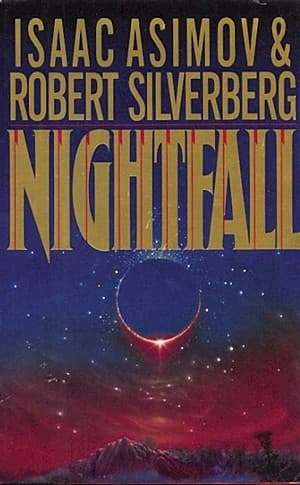

The Setup
Okay, so this one's a bit different. At 1 hour 32 minutes, Nightfall is basically a long commute - I knocked it out on a single round trip to Mountain View. And honestly? That's kind of perfect for what this is: Asimov's most famous short story, the one that Science Fiction Writers of America voted the best sci-fi short ever written before 1965. No pressure or anything.
I'd been meaning to get to this for years. Like, embarrassingly long. I've read Foundation, I've done the robot novels, but somehow this classic short just... sat there on my list. Then I saw it pop up on a "best sci-fi audiobooks under 2 hours" thread and figured why not. It's shorter than most podcasts I listen to about database optimization. (Yes, Kevin judges me for those. Yes, I deserve it.)
What Asimov Gets Right
The premise is deceptively simple: what happens to a civilization on a planet with six suns - a world that has never known true darkness - when all six suns set at once? Nightfall. For the first time in 2,049 years.
And look, this is Asimov from 1941. The prose is utilitarian. The characters are basically idea-delivery vehicles. But the concept? The slow-building dread as scientists try to warn a society that literally cannot comprehend what darkness means? That holds up. The science actually holds up too, mostly - Asimov does the math on the orbital mechanics, and while it's hand-wavy in places, it's not embarrassing.
What got me was the psychological angle. These people have never seen stars. They don't know stars exist. And when the darkness comes and they suddenly see thousands of points of light in the sky for the first time... well. Let's just say it doesn't go great for their collective sanity. There's something genuinely unsettling about imagining a species whose entire worldview - literally their understanding of the universe - gets shattered in a single night.
The story builds like a good debugging session. You start with a weird anomaly (why are there ruins of previous civilizations that all collapsed roughly every 2,000 years?), and then you trace it back, piece by piece, until suddenly the whole system makes horrible sense. I appreciated that.
The Voice Behind It
Stephen Eley's narration is... interesting. He's got this earnest, almost podcast-host quality to his delivery - which makes sense, he's the founder of Escape Pod, the sci-fi podcast. There's a sense of wonder in how he reads it, like he genuinely loves this material. His pacing is solid, giving the revelations room to land without dragging.
The character voices are distinct enough that I could follow who was talking on a crowded 6AM train, which is my baseline requirement. The scientists sound appropriately academic and frustrated. The journalist character has this skeptical edge. It works.
That said - and I have to be honest here - I can see why some people find him a bit much. There's an enthusiasm to his delivery that borders on theatrical at times. If you're looking for a subtle, understated performance, this isn't it. He's performing the story, not just reading it. I didn't mind, but your mileage may vary.
At 1.5x speed (my default), it flowed perfectly. The production is clean, no weird audio artifacts or background noise. Pretty much what you'd want from a short story recording.
Fair Warning
This is a short story, not a novel. If you're expecting the depth of a full Asimov book, you'll be disappointed. The characters are thin. The ending is abrupt - intentionally so, but still. And if you've already read the novelization that Asimov and Silverberg did later, this original version might feel incomplete.
Also, this is 1941 science fiction. The writing style is dated. There are no female characters with speaking roles (ugh). It's very much a product of its time, for better and worse.
But as a piece of sci-fi history? As a thought experiment about perception and civilization and what we take for granted? It's worth 90 minutes of your life.
The Verdict
TL;DR: Worth your commute. This is basically "what if society had never seen the dark" as a psychological horror story, and Asimov executes the premise with the kind of logical precision that made him famous. Eley's narration brings genuine enthusiasm to the material, even if it's not for everyone.
Perfect for: A single commute, a short flight, or when you want to feel like you accomplished something literary without committing to a 20-hour epic.
Skip if: You need deep character work, or you've already read the expanded novel version and don't need the original.
The ROI on this audiobook is surprisingly high - it's free in a lot of places, it's under two hours, and it's legitimately one of the foundational works of the genre. I finished this in one commute and spent the rest of the day thinking about what it would be like to see stars for the first time.
Not bad for a story older than my grandmother.