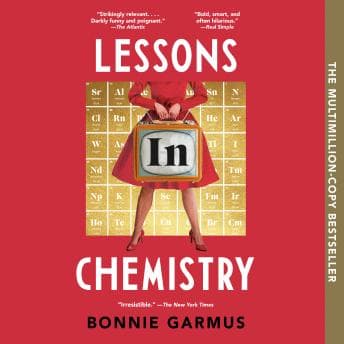

Look, I'll be honest. I started this one skeptical. A cooking show in the 1960s? Feminist chemistry? It sounded like it could go very wrong very fast - like someone trying to write "Mad Men" but with beakers and bunsen burners. I was grading sophomore essays on "The Great Gatsby" (why do they all think the green light means money? It's hope, people, hope) and needed something to keep me from writing increasingly sarcastic margin comments.
By hour three, I'd forgotten about Nick Carraway entirely. And honestly? My students' papers were better for it.
What Garmus Actually Understands
Here's the thing about Elizabeth Zott that makes her work as a character: she's not written as a symbol. She's not "Woman Fighting The Patriarchy" in capital letters. She's a scientist who happens to be a woman in a decade that had no idea what to do with her. The distinction matters.
Garmus writes her with this clinical precision that mirrors how Elizabeth herself sees the world - everything is observable, measurable, reducible to its chemical components. Including, frustratingly for her, human emotion. It's a neat trick. The prose style is the character. This reminds me of what Hemingway said about writing - that the dignity of movement of an iceberg is due to only one-eighth of it being above water. Elizabeth's emotional depth is all submerged, and Garmus trusts us to feel it anyway.
The supporting cast is where things get genuinely surprising. Six-Thirty, the dog, is somehow one of the most fully realized characters I've encountered in contemporary fiction. (Don't tell my students I said that - they'll think I've finally lost it.) He's not a cute pet or comic relief. He's a perspective, complete with his own vocabulary limitations and philosophical observations about human behavior. It shouldn't work. It absolutely does.
The Narration Situation
So this audiobook has three narrators: Bonnie Garmus herself, Miranda Raison, and Pandora Sykes. I couldn't find much about how they split the duties online, but based on my listening, Raison carries most of the heavy lifting with the main narrative, and she nails it.
Her Elizabeth is exactly right - measured, precise, with this undercurrent of bewildered frustration at a world that keeps refusing to make logical sense. The pacing in the early chapters is deliberate, maybe too deliberate for some listeners. I heard it as intentional. Elizabeth's world is methodical. The narration should be too.
Where Raison really shines is in the contrast work. When she shifts to the TV executives or the condescending male scientists, there's this subtle shift - not cartoonish, just... slightly off. Like she's letting us hear how ridiculous they sound without editorializing. That's performance art. The narrator understands that pause is punctuation.
The author narration sections (I'm assuming these are the podcast-style interludes?) add an interesting layer. Garmus reading her own work has this warmth that the main narrative deliberately lacks. It's a nice counterbalance.
Where It Drags (And Where It Doesn't)
I'll be real for a second. The middle section - roughly hours five through seven - meanders. The setup for the cooking show takes longer than it needs to, and some of the workplace politics at Hastings feel repetitive. Yes, we understand that men in the 1960s were dismissive of women scientists. We got it the first four times.
But then the cooking show actually starts, and everything clicks into gear. Elizabeth explaining chemistry to housewives, refusing to dumb down the science, treating her audience like the intelligent adults they are - it's genuinely moving. The prose deserves to be savored here. Garmus is making a point about how we talk to women, about the assumption of incompetence baked into so much of mid-century American culture, and she's doing it through vinegar and baking soda.
The ending hit harder than I expected. I was walking the lakefront with Denise, pretending I wasn't tearing up behind my sunglasses. (She knew. She always knows.)
Who This Is Actually For
If you loved "A Gentleman in Moscow" for its patient character work, this is its spiritual successor - different setting, different tone, but the same trust in the reader to appreciate slow-burn development. If you need constant plot momentum, this might test your patience.
My students would hate this. The pacing is too deliberate, the humor too dry, the feminism too embedded in character rather than announced in neon. I love it. Worth pausing the faculty meeting for - and I did, multiple times, because Principal Martinez's quarterly budget updates cannot compete with a dog philosophizing about the nature of loyalty.
The 1.0x speed is non-negotiable here. Raison's delivery has these micro-pauses that carry meaning. Speed it up and you lose half the characterization.
The Verdict
This is a book about a woman who refuses to be less than she is, narrated by someone who understands that restraint is its own kind of power. It's funny in that quiet, observational way that sneaks up on you - I laughed out loud on the train twice and had to pretend I was coughing.
Not perfect. The middle sags, some of the male characters are a bit one-note, and there's a subplot about Elizabeth's past that feels slightly underdeveloped. But when it works - and it works more often than it doesn't - it's the kind of book that makes you want to recommend it to everyone you know.
Especially the ones who think audiobooks are cheating. They're wrong, obviously. But this one might convince them.