
TL;DR: Worth your commute. All 21 hours of it.
Look, I'm just gonna say it - I've been putting off Dune for years. I know, I know. Hand in my sci-fi card. But here's the thing: 21 hours is a commitment. That's like two weeks of commutes, minimum. And I'd heard the book was dense, political, had made-up words for everything. Basically the opposite of what you want when you're half-conscious on the 6:47 AM train surrounded by people who definitely shouldn't be eating breakfast burritos in an enclosed space.
But then Villeneuve's movie came out, Kevin wouldn't shut up about it, and I figured - okay, fine. Let's do this.
Best decision I've made since switching to 1.5x playback speed.
The Full Cast Thing Actually Works
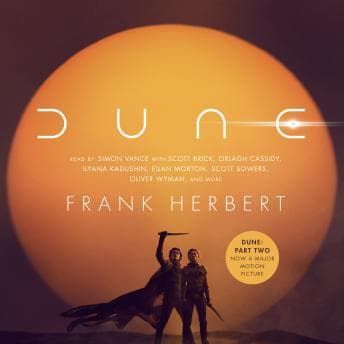
So this version has like... twelve narrators? Which sounds insane. I was fully prepared to hate it. Multiple narrators usually means jarring transitions, inconsistent energy, that thing where you're suddenly trying to figure out who's talking because someone new just jumped in.
But they actually pulled it off. Simon Vance handles a lot of the heavy lifting (and if you've listened to any sci-fi audiobooks, you know his voice - the man is everywhere for a reason). Scott Brick does Paul, which works because he's got that young-but-not-annoying quality that's surprisingly hard to find. The women in the cast - Orlagh Cassidy and Ilyana Kadushin especially - bring real weight to Jessica and the Bene Gesserit scenes.
The character differentiation is genuinely impressive. Baron Harkonnen sounds like a different person than Duke Leto, which sounds obvious but I've listened to audiobooks where the villain and hero have basically the same voice with slightly different inflections. Here, you always know who's speaking. That matters when you're trying to follow political intrigue while also trying not to miss your stop.
Where Herbert's Density Becomes a Feature
Okay, so the book IS dense. There's no getting around that. Herbert throws terminology at you - the Bene Gesserit, the Kwisatz Haderach, the gom jabbar, stillsuits, spice melange - and expects you to keep up. In print, I probably would've been flipping back constantly. But in audio? The narrators' pronunciations actually help anchor the terms. By hour three, I wasn't even thinking about it anymore.
The pacing is... deliberate. That's the diplomatic way to put it. The first few hours are a lot of setup - political maneuvering, house dynamics, Paul's training. If you're expecting action-adventure sci-fi, you might zone out. But if you're into worldbuilding (and I mean REAL worldbuilding, not just "here's a map and some funny names"), this is basically a masterclass.
The science actually holds up, too. Or at least, the internal logic does. Herbert built an entire ecosystem around water scarcity, and it all connects - the stillsuits, the Fremen culture, the sandworms, the spice. It's the kind of systems thinking that makes my engineer brain happy. This is basically a distributed systems architecture, but for a desert planet. (Yes, I know how that sounds. Kevin already made fun of me.)
The Listening Experience (Real Talk)
I finished this in about 14 commutes, spread over three weeks. Here's what worked and what didn't:
Perfect for: Train rides, long drives, flights. Anything where you can give it 70% attention minimum. This is NOT a background-noise audiobook. You will miss important stuff if you're also debugging code or answering Slack messages.
Skip for: Gym sessions (too much plot to follow while also trying not to die on the treadmill), falling asleep (you'll wake up confused about which house betrayed which other house).
Speed recommendation: I did 1.25x, which felt right. 1.5x was too fast for the dense political sections - I kept having to rewind. The narrators have good pacing already, so you don't need to speed them up much.
The production quality is clean. No weird audio artifacts, smooth transitions between narrators. I've listened to full-cast productions that sound like they were recorded in different rooms with different equipment - this isn't that.
Fair Warning
A few things that might bug you:
The accents aren't always consistent. Some characters sound vaguely British, others American, and it's not always clear why. It didn't bother me much, but if that's a pet peeve, you'll notice.
Also - and this is a Herbert thing, not a narrator thing - the internal monologue can get... extensive. Paul thinks a LOT. Jessica thinks even more. If you're not into characters analyzing their own thoughts and motivations in real-time, this might drive you nuts.
And honestly? The ending doesn't really END. It's clearly book one of a series. The main conflict resolves, but there's a lot left hanging. I immediately started the second book, which is either a recommendation or a warning depending on how you feel about 21-hour commitments.
The Verdict
The ROI on this audiobook is high. Yeah, it's a time investment. But it's also one of those foundational sci-fi texts that everything else references, and the full-cast production actually makes it MORE accessible than reading it would be. The narrators do the heavy lifting of keeping characters straight and making the terminology feel natural.
If you've seen the Villeneuve movie and want to go deeper - this is the way. If you're a sci-fi fan who's been avoiding Dune because it seems intimidating - same. The audiobook format genuinely helps.
Perfect for: train, long drives, flights. Skip for: gym, falling asleep, anything requiring divided attention.
Now if you'll excuse me, I have five more books in this series to get through. Kevin is already insufferable about it.