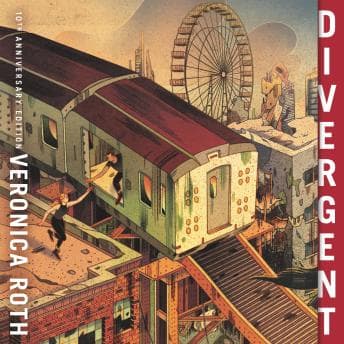

I'll be honest - I came to Divergent late. Like, embarrassingly late. My students have been telling me to read this for years, and I kept waving them off with "I'll get to it" while secretly thinking I was too good for YA dystopia. (I wasn't. I'm not. Pride goeth before a really engaging audiobook.)
So there I was, walking the lakefront with Denise on a Saturday morning, finally giving in. And look, eleven hours later, I get it. I finally get why half my sophomore class has faction symbols drawn on their notebooks.
Emma Galvin Gets Tris
Here's the thing about first-person YA narration - it can go wrong in about fifteen different ways. Too breathy. Too dramatic. Too much "I'm a teenager and everything is THE WORST." Emma Galvin doesn't do any of that. She finds this gruff, slightly husky quality that makes Tris feel like an actual sixteen-year-old who's been raised to suppress herself and is only now figuring out she's allowed to want things.
The narrator understands that pause is punctuation. When Tris makes her choice at the Choosing Ceremony - and I won't spoil it for the three other people who are as late to this as I was - Galvin lets the moment breathe. She doesn't rush past it. She doesn't oversell it. She just... sits in it. That's performance art.
Now, fair warning: the male voices aren't her strongest suit. Four sounds fine, but some of the other guys blur together a bit. My students would probably roast me for caring about this, but when you've spent twenty years teaching kids to pay attention to distinct character voices in literature, you notice these things. It's not a dealbreaker. It's just there.
The World-Building Question
Okay, so. Let's talk about what Roth is really doing here.
The faction system is ridiculous. I mean that as a compliment and a criticism. It's ridiculous in the way that 1984's ministries are ridiculous, or the Capitol's excess in The Hunger Games. It's not supposed to be realistic - it's supposed to be a mirror held up at an angle. Candor, Abnegation, Dauntless, Amity, Erudite. Honesty, selflessness, bravery, peace, intelligence. What happens when you force people to choose one virtue and pretend the others don't matter?
This is why we still read the classics, honestly. Because Roth is doing something that goes back to Plato's Republic - asking what happens when you try to engineer a perfect society by sorting humans into categories. (Don't tell my students I compared their favorite YA book to Plato. They'll think I'm trying too hard. Which I am.)
The audiobook pacing handles the world-building well. Galvin keeps things moving through the exposition without making it feel like a textbook. By the time Tris is jumping off trains and getting punched in the face during Dauntless initiation, you're invested enough in the world that the action hits harder.
Where It Dragged (And Where It Didn't)
I'm not going to pretend this is Faulkner. The prose is functional - it does what it needs to do and gets out of the way. Roth isn't trying to write beautiful sentences; she's trying to keep you turning pages. Or in this case, keep you walking past your usual turnaround point because you need to know what happens next.
The middle section of Dauntless training? That flew by. I graded an entire stack of essays without really registering them because I was too busy listening to Tris figure out how to throw knives. (My students' grades may have been slightly more generous that night. You're welcome, third period.)
But some of the romantic tension with Four felt... I don't know. A little paint-by-numbers? Galvin does her best to sell it, and she mostly succeeds, but there were moments where I could feel the YA formula clicking into place. Brooding mysterious guy. Protagonist who doesn't realize she's special. You know the beats.
That said - and this is important - the book earns its emotional moments. When the violence escalates in the final act, it doesn't feel gratuitous. It feels like the logical consequence of everything the faction system has been building toward. The prose deserves to be savored in those final chapters, and Galvin rises to meet it.
Who Should Listen
If you loved The Hunger Games, this is its spiritual successor. Same DNA, different execution. If you're a parent trying to understand what your kid is reading, this is a solid entry point into modern YA dystopia. If you're a high school English teacher who's been dismissing this genre for years... well, join the club. We have humble pie.
Consider skipping if you need your dystopias to be rigorously logical. The faction system falls apart if you poke it too hard. Also skip if you're sensitive to violence - the Dauntless initiation gets brutal, and the climax doesn't pull punches.
I listened at 1.0x because - say it with me - the author chose those words. But honestly? This one could handle 1.15x without losing anything. The pacing is brisk enough that speeding up slightly won't hurt.
The Verdict
Worth pausing the faculty meeting for. (Sorry again, Principal Martinez.)
Emma Galvin won an AudioFile Earphones Award for this, and she earned it. She takes a protagonist who could easily feel blank on the page and gives her texture, grit, vulnerability. The production is clean, the pacing is right, and by the end, I understood why my students keep drawing those faction symbols.
I'm starting Insurgent tomorrow. Don't tell anyone I'm this invested. I have a reputation to maintain.