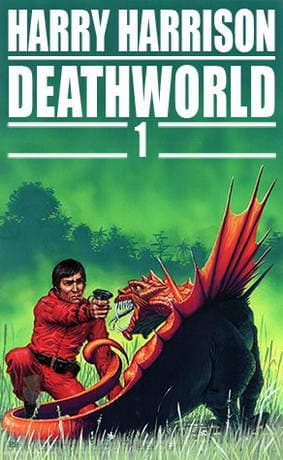

When the Planet Wants You Dead (And Your Narrator is an Accountant)
Okay, look. I should be writing code right now. My thesis advisor, Dr. Patel, thinks I'm currently running simulations on procedural terrain generation. And technically, I am thinking about terrain. Specifically, terrain that wants to murder you.
I just finished Harry Harrison's Deathworld at 2 AM with a lukewarm Red Bull, and honestly? It’s basically what happens when a Dungeon Master decides he's tired of the party's nonsense and just wants a TPK (Total Party Kill).
(Don't tell my mom I'm listening to pulp sci-fi instead of graduating. She thinks I'm "studying.")
The Ultimate Survival Mode
Here's the pitch: Jason dinAlt is a professional gambler with some psychic mojo who decides to go to Pyrrus. Why? Because he's an idiot. Or an adrenaline junkie. Probably both. Pyrrus is the deadliest planet colonized by humans. We're talking double gravity, violent tectonic shifts, and local flora/fauna that evolve in real-time just to kill you.
From a world-building perspective? It's chef's kiss.
Harrison wrote this back in 1960, and you can tell, but the ecological hostility is super compelling. It feels like the precursor to every "hostile planet" survival game on Steam right now. The planet is literally an antagonist. I love that. In my own thesis (which I am definitely working on, I swear), I'm trying to get my algorithms to generate conflict naturally, and Harrison just does it by making the grass try to eat you.
The "New York Accountant" Vibe
Let's talk about Gregg Margarite.
If you're used to Steven Pacey or Ray Porter doing distinct voices for every goblin and spaceship captain, you need to reset your expectations. Way down. Margarite is a LibriVox legend (RIP to a real one), but this is a volunteer recording, and it sounds like it.
One reviewer described his style as "being read to by a New York accountant," and—I laughed out loud—that is painfully accurate. He's got this clear, intelligent, slightly monotone delivery. He doesn't really act the characters. Jason dinAlt sounds exactly like the grumpy colonists, who sound exactly like the narrator.
But here's the thing—it kinda works?
Maybe it's the Golden Age sci-fi writing style. The prose is direct, punchy, and a little dry. Margarite's "just the facts, ma'am" delivery fits the vibe of a 1960s serial. He's not trying to win an Oscar; he's just telling you how Jason almost got crushed by a heavy-G animal. It’s consistent. It’s clear. And honestly, sometimes I just want a story read to me without the narrator chewing the scenery.
(Though, yeah, the audio quality has a bit of background noise. It's not studio polish. You've been warned.)
Why It's Worth 5 Hours of Your Life
It's short. Like, 5 and a half hours short. I listened to the whole thing in one coding marathon.
The pacing is relentless. There's no 40-page description of a feast (looking at you, GRRM). It's just: Jason lands -> Planet tries to kill him -> Jason gambles -> Planet tries to kill him harder.
If you like the Stainless Steel Rat books or just want to see where modern survival sci-fi came from, give it a shot. It's got that retro charm where men were men, planets were death traps, and problem-solving involved a lot of guns and psychic powers.
Just don't go in expecting a cinematic soundscape. This is old-school storytelling for people who appreciate the classics. Now, if you'll excuse me, I have to figure out how to explain to Dr. Patel why my procedural generation code now includes "carnivorous grass."