
I finished this one on a Saturday morning, walking the lakefront with Denise while the fog was still burning off Lake Michigan. We'd been walking for maybe two hours before I realized I hadn't said a word to her. She finally tapped my shoulder and asked if I was okay. I pulled out an earbud and just said, "I need a minute." She knew. Twenty years of marriage, she knows when a book has wrecked me.
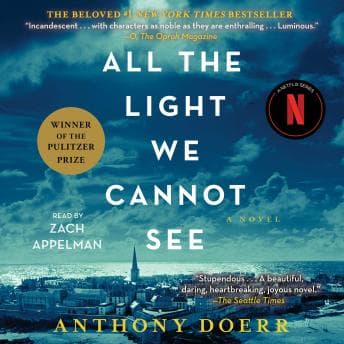
Anthony Doerr spent ten years writing this novel. Ten years. And honestly? You can feel every single one of them in the prose. This is the kind of book I try to get my juniors to understand when I'm teaching them about craft - that sentences can do more than convey information. They can make you feel the texture of a seashell, the static hiss of a radio coming to life, the particular terror of a city being bombed into rubble around you.
The Structure That Shouldn't Work (But Does)
Look, I'll be honest with you. When I first started listening, the non-linear timeline almost lost me. We're bouncing between Marie-Laure in occupied France and Werner in Nazi Germany, jumping years forward and back, and I thought - okay, this is going to be one of those books. The kind where the author is showing off.
But here's the thing. Doerr isn't showing off. He's doing something much more interesting. The fragmented structure mirrors how memory actually works, especially traumatic memory. We don't remember war chronologically. We remember the smell of bread before the bombing. The sound of a voice on a radio. The weight of a diamond that may or may not be cursed. (My students would roll their eyes at me for that interpretation. They can write their own reviews.)
The chapters are short - sometimes just a page or two - which makes this surprisingly perfect for audiobook listening. I could pause between chapters while waiting in line at the grocery store and not lose the thread. The brevity creates this almost cinematic quality, like watching a film where every shot is carefully composed.
Zach Appelman Gets It
I'm going to say something that might sound hyperbolic, but I mean it: Zach Appelman understands that narration is interpretation. He's not just reading Doerr's words. He's performing them.
His voice has this quality - warm but restrained - that perfectly matches the novel's tone. When he reads Marie-Laure's sections, there's a gentleness there, a sense of wonder that captures how she experiences the world through touch and sound and smell. When he shifts to Werner, something hardens. Not dramatically - Appelman is too smart for that - but subtly. You can hear the weight of complicity settling onto this boy's shoulders.
The German and French accents are handled with a light touch. Some narrators would lean into the accents until they become distracting, but Appelman just... suggests them. It's enough to ground you in place without pulling you out of the story. This is what I mean when I tell my students that restraint is a choice. The narrator understands that pause is punctuation.
That said - and I want to be fair here - some listeners have found his pacing slow. I've seen reviews calling it "overly sentimental." I don't agree, but I understand the criticism. If you're someone who listens at 1.5x or 2x speed, this might feel like wading through honey. I listened at 1.0x because the author chose those words, and Appelman chose his pauses, and I wanted to hear both. But I know I'm ancient for this take.
What Doerr Is Really Saying
This is a war novel that's barely about war. It's about radio waves and seashells and the tiny acts of goodness people manage even when the world is burning. Marie-Laure's father builds her a miniature model of their neighborhood so she can navigate by touch. Werner fixes radios and dreams of something beyond the mines. These aren't grand heroic gestures. They're small, human, desperately ordinary.
The novel asks a question I've been turning over since I finished: What do we owe each other? Werner has a gift - he can build and fix radios - and the Nazis exploit that gift to hunt down resistance fighters. His talent becomes a weapon. Is he responsible for how it's used? The book doesn't give easy answers. (Good books never do.)
If you loved The Book Thief, this is its spiritual successor - another WWII novel told from unexpected perspectives, another meditation on how stories and words and small kindnesses can be acts of resistance. But where Zusak uses Death as a narrator for distance, Doerr pulls you in close. Uncomfortably close.
Fair Warning
Sixteen hours is a commitment. And this isn't a book with a lot of plot momentum. If you need things to happen constantly, you might struggle. The novel is more interested in moments than in action - the way light fractures through a window, the sound of the sea against the walls of Saint-Malo, the feeling of running your fingers over a model of a city you can no longer see.
Also, if you're coming to this after watching the Netflix adaptation, know that the audiobook is a different experience entirely. The show compressed and simplified. The novel sprawls and lingers. Both have their merits, but they're not the same story.
The Verdict
I'm giving this to my AP Lit students next semester. Not because it's an easy read - it isn't - but because it's the kind of book that teaches you how to read. How to slow down. How to pay attention to sentences. How to let a story work on you over time.
This is why we still read the classics, or in this case, why we'll still be reading this one in fifty years. The prose deserves to be savored. Appelman's narration deserves to be heard at full speed. And you deserve sixteen hours of walking by a lake, or doing dishes, or pretending to listen to a budget presentation, while this story quietly breaks your heart.
Worth pausing the faculty meeting for. Worth everything, actually.