
The Perfect Commute Companion (Literally)
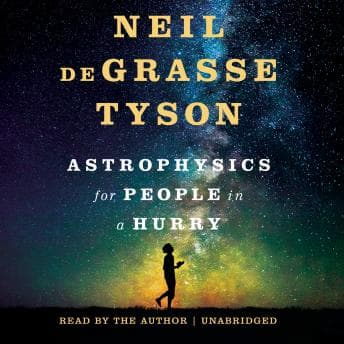
Okay, so here's the thing. This audiobook is basically designed for me. Neil deGrasse Tyson wrote a book specifically for people on trains, waiting for coffee, killing time at the DMV - and then he narrates it himself in under four hours. The ROI on this audiobook is absurd. I finished it in two commutes with time to spare.
I started this on a Monday morning, 6:12 AM, Caltrain pulling out of SF. I was running on maybe five hours of sleep after a weekend deploy that went sideways (don't ask), and I figured - you know what, let's see if astrophysics can penetrate this fog. And honestly? It did. Tyson has this way of explaining things like dark matter and the cosmic microwave background radiation that feels like your really smart uncle is just... talking to you. Not lecturing. Talking.
Why Author-Narrated Actually Works Here
Look, I'm usually skeptical of author-narrated audiobooks. Writers aren't voice actors. But Tyson is basically a professional explainer at this point - the man has hosted Cosmos, he's been on every podcast known to humanity, he's got that warm, slightly theatrical delivery down to a science (pun intended). His voice flows smooth, like he's genuinely excited to tell you about quarks and you're the first person he's gotten to share this with today.
The pacing is perfect for half-awake listening. Each chapter is bite-sized - we're talking 10-15 minutes max - and he gives you these little mental breaks between concepts. It's not a firehose of information. More like... a well-designed API that returns data in manageable chunks. (Sorry, I warned you about the tech metaphors.)
That said, I did catch myself rewinding a couple times during the quantum mechanics section. Not because Tyson wasn't clear, but because quantum mechanics is just... quantum mechanics. Some things require your brain to be fully online, and mine wasn't always cooperating at 6 AM. If you're the type who needs to deeply understand every concept before moving on, you might want to read this one instead. But if you're okay with getting the gist and feeling generally smarter about the universe? Audio works great.
The Science Actually Holds Up
I appreciate that Tyson doesn't dumb things down to the point of being wrong. He simplifies, sure, but he's not lying to you. When he talks about the Big Bang or black holes or the search for exoplanets, you're getting real science, just... compressed. It's like a well-written README - gives you everything you need to understand the system without drowning you in implementation details.
My favorite parts were the bits about cosmic perspective - how we're made of star stuff, how the same laws of physics apply everywhere in the universe, how profoundly small and yet connected we are. I know, I know, it sounds cheesy when I write it out. But when Tyson delivers it with that mix of wonder and matter-of-factness, it hits different. I may have gotten a little emotional somewhere around Millbrae. (The guy next to me was asleep, so no witnesses.)
Some listeners apparently find overlap with his other work or his StarTalk podcast. I've heard a few episodes but I'm not a regular listener, so most of this felt fresh to me. Your mileage may vary if you've consumed a lot of Tyson content already.
Who Should Listen
Perfect for: commute, gym, chores. Anything where you want to feel like you're learning something without having to take notes.
Skip for: deep work or situations where you need to retain every detail. This is more "expand your mind" than "study for an exam."
If you're already into astrophysics, this might feel too basic. It's very much an intro - Tyson even says it's for people in a hurry. But if you're a tech person who wants to sound smart at dinner parties when someone brings up dark energy? This is your cheat code.
The Verdict
TL;DR: Worth your commute. Absolutely.
At 3 hours and 41 minutes, this is one of the most efficient audiobooks I've listened to this year. Tyson delivers exactly what the title promises - a crash course in astrophysics that respects your time while still blowing your mind a little. The production is clean, his narration is engaging, and you'll come out of it with a better understanding of, like, existence.
I listened at 1.25x - his natural pace is already pretty good, so you don't need to crank it much higher. Anything above 1.5x and you might miss some of the nuance.
Kevin asked me what I learned and I spent 20 minutes explaining the multiverse theory to him while he made dinner. He seemed... less impressed than I was. But that's fine. More cosmic wonder for me.