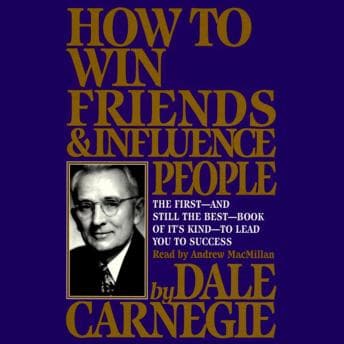

Look, I'll be honest—I picked this up because I was tired of reading academic papers about influence and persuasion that cite Carnegie but never actually engage with the source material. My therapist would have thoughts about this character trait of mine. The need to go back to primary sources. The inability to just trust the summary.
So there I was, jogging through Cambridge at 6 AM, listening to a book written during the Great Depression about how to make people like you. The irony wasn't lost on me.
The Psychology That Actually Holds Up
Here's the thing about Carnegie that most people miss: he wasn't writing a manipulation manual. He was writing a behavioral psychology textbook before behavioral psychology was really a thing. The principles he outlines—genuine interest in others, remembering names, making people feel important—these aren't tricks. They're recognition of fundamental human needs.
The research actually shows that Carnegie was onto something real. His emphasis on validation, on making others feel heard? That's attachment theory and self-determination theory wrapped in 1930s business speak. When he talks about avoiding criticism and giving honest appreciation, he's describing what we now call positive reinforcement and psychological safety. The man was doing applied psychology without the jargon.
What makes this book compelling—psychologically speaking—is that Carnegie understood something my students still struggle with: people don't change their minds because you prove them wrong. They change because you make it safe to change. That's not manipulation. That's just understanding how human brains actually work.
Andrew Macmillan's Delivery (And Where It Gets Complicated)
Macmillan has this neutral, clear delivery that works well for the instructional parts. His pacing is measured, which honestly helped me absorb the material while dodging joggers and cyclists. The audio quality is crisp—no complaints there.
But here's my issue. Carnegie's book is full of these historical anecdotes—stories about Lincoln, about business tycoons, about regular people navigating difficult conversations. These stories need life. They need emotional texture. And Macmillan's delivery can feel a bit... clinical? Like he's reading a textbook rather than telling you about the time Abraham Lincoln wrote a scathing letter and then never sent it.
I found myself wishing for more vocal variety. When Carnegie describes someone's transformation—how they went from being hated to being respected—that's a character arc. That's drama. Macmillan doesn't quite lean into those moments. It's competent, absolutely. But "competent" isn't the same as "captivating."
(Don't get me wrong—I've heard worse. Way worse. But this book deserves narration that matches its emotional intelligence.)
The Dated Parts (Because We Need to Talk About It)
Okay, so. This is a book from 1936. Some of the examples feel like time capsules. The gender dynamics in certain anecdotes made me wince. The assumption that "influence" primarily happens in male-dominated business settings is... well, it's of its era.
But here's what I found myself asking: does the underlying psychology hold up even when the examples don't? Mostly yes. The principle that people crave recognition doesn't expire. The idea that you catch more flies with honey than vinegar isn't revolutionary, but it's still true.
The "updated for today's readers" claim in the description is generous, though. The updates feel surface-level. I would've loved to see modern examples—how these principles apply to email communication, to social media, to remote work dynamics. That's a missed opportunity.
Who Should Actually Listen to This
This is a fascinating case study in how popular psychology gets transmitted across generations. If you're in management, sales, or any field requiring persuasion, the core principles remain solid. If you're a psychology nerd like me, it's worth hearing the source material that launched a thousand business books.
But if you're looking for cutting-edge behavioral science? This isn't it. It's the foundation, not the frontier.
I found it most useful during my morning jogs and while cooking—activities where I could process and reflect rather than just passively absorb. It's not a book that demands your full attention, which is both a strength and a limitation.
The protagonist of this book—if we can call Carnegie's ideal reader a protagonist—exhibits classic people-pleasing tendencies that the book then tries to channel into something productive. My therapist would have thoughts about this character. But that's another review entirely.
Final Thoughts
Carnegie understood human nature. He understood that we're all walking around desperate to feel important, to be heard, to matter. That insight hasn't aged a day.
Macmillan's narration delivers the content clearly, even if it doesn't elevate it. At 7 hours, it's a reasonable time investment for foundational material that still gets cited in every leadership seminar you'll ever attend.
Will it transform your life? Probably not. But it might make you pause before sending that snarky email. And honestly? That's worth something.